
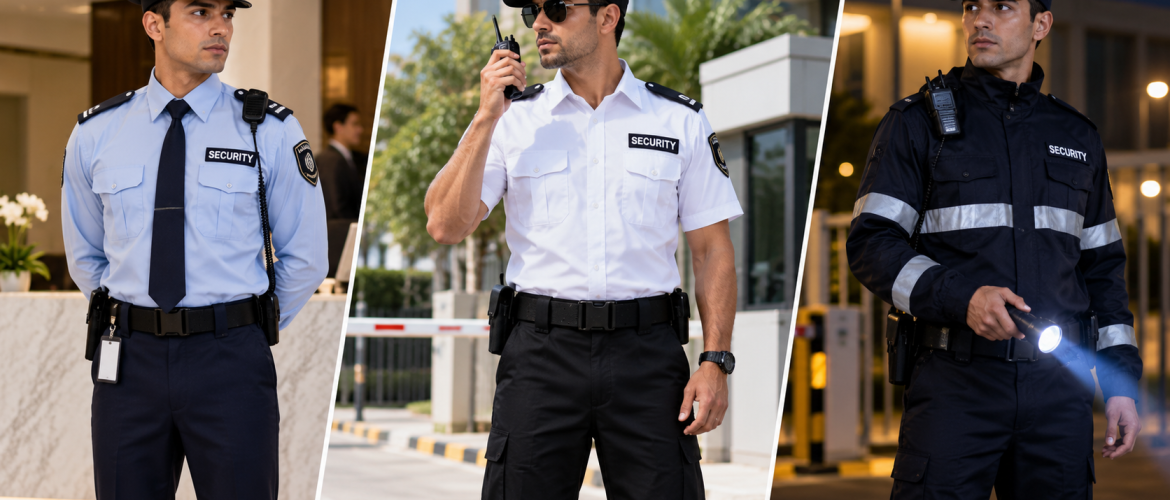
A visitor, a tenant or a colleague should be able to tell who is in charge within a few seconds. A well-planned security guard uniform makes that possible.
Most of the attention goes to fabric, fit and visibility. Identification is just as important: how does the uniform show who is a guard, who is a supervisor and who is on the control desk? This guide explains how to build a rank and role identification system using badges, epaulettes, patches, name tags and colour accents. For fabric and shift planning, see our guides to security uniforms for indoor, outdoor and night-shift guards and durable fabrics for security uniforms.
What Is a Rank and Role Identification System?
It is a simple set of uniform features that shows a guard’s level or role at a glance, such as shoulder slides, badges or patches, applied the same way across the whole team.
Why It Matters
- Clear authority: People know whom to approach.
- Easier supervision: Supervisors can see who is on duty and in which role.
- Team discipline: A visible structure supports reporting lines.
- Professional image: A consistent system looks organised to clients and visitors.
Step 1: Define the Roles
List the roles in your security team. Examples:
- Security guard
- Senior guard
- Patrol or gate guard
- Reception or concierge guard
- Control room operator
- Shift supervisor
- Site manager
Keep the number of levels small. Three or four visible levels are easier to read than eight.
Step 2: Choose the Identification Elements
Common elements include:
- Epaulettes or shoulder slides: Show level through colour, bars or stripes.
- Badge or emblem: A company badge on the chest or arm.
- Sleeve patches: Show company name or role.
- Name tag or ID holder: Shows the person’s name and ID.
- Collar accents or piping: Subtle colour differences between levels.
- Cap badge: Reinforces identity when caps are worn.
You do not need all of them. Pick the few that make roles clear.
Step 3: Decide What Each Level Shows
Create a simple table for your team. For example:
| Role | Identification |
|---|---|
| Guard | Company badge, name tag, standard slides |
| Senior guard | Same as guard plus one marked slide feature |
| Supervisor | Different slide colour or bars, plus role patch |
| Control room | Role patch or collar accent |
This is an example only. Use your own structure and keep it documented.
Step 4: Set Placement Standards
Decide exactly where each item sits and write it down:
- Badge position on the chest or sleeve
- Name tag side and height
- Patch position on the sleeve
- Slide direction and spacing
- Cap badge position
Consistent placement makes a team look uniform and makes new items easy to apply on repeat orders.
Step 5: Choose How Items Are Applied
Think about wear and washing:
- Embroidered badges and patches: Hard-wearing and look neat.
- Woven patches: Suitable for detailed logos.
- Printed marks: Suitable where fine detail or lighter garments are needed.
- Removable slides or tags: Useful when a person changes level without a new shirt.
Removable items for rank make promotions easier, because only the slide changes.
Step 6: Keep Identification Consistent Across Uniform Sets
If your team has indoor, outdoor and night-shift sets, the same identification should appear on all of them: logo, “Security” wording, name tag and rank features. This keeps the team recognisable, whatever the garment.
Step 7: Make Wording and Marks Readable
- Use clear, high-contrast text.
- Keep wording short.
- Choose sizes readable from the distance people will see them.
- Avoid decorative fonts.
- Check the design at night and in strong light.
For more on visibility, read our guide to high-visibility features in security uniforms.
Step 8: Check Applicable Requirements
Uniform design for security teams may be subject to requirements from the company, the client site or the relevant authority. Check what applies to your operation before finalising the design, and share it with your uniform maker.
Step 9: Sample, Check and Approve
Ask the maker for a sample with all identification items attached. Check:
- Readability from a distance
- Position and spacing
- Comfort of shoulder items and badges
- How items look after washing
- Whether the system is understood by a few guards
Approve in writing only after the sample is correct.
Step 10: Document the Standard
Keep a one-page standard showing the role table, placement drawings, colours and approved sample. This keeps repeat orders consistent and helps new joiners dress correctly.
Common Mistakes
- Too many levels or too many colours
- Placement that differs between guards
- Small text that cannot be read from a distance
- Different identification on indoor and outdoor sets
- No documentation
- Attaching items permanently when roles change often
Identification System Checklist
- Roles listed
- Number of levels agreed
- Elements chosen
- Role table written
- Placement drawn
- Application method chosen
- Consistency across sets checked
- Applicable requirements checked
- Sample approved
- Standard documented
How Tex Design Can Help
Tex Design Uniforms supplies security uniforms in Dubai and the UAE, including shirts, trousers, blazers and suits, with embroidery and printing for badges, wording and logos. Share your role structure and the maker can help you plan how each item is applied. Browse our security uniforms page or contact Tex Design.
Conclusion
A good security guard uniform does more than look smart. With a short list of roles, a few clear identification elements, consistent placement and a documented standard, the whole team becomes easier to recognise and supervise.
Frequently Asked Questions
How can a security guard uniform show rank?
Through features such as epaulettes or slides, badges, patches, collar accents or different colours, applied the same way across the team.
How many rank levels should a uniform show?
Keep it simple. Three or four visible levels are usually easier to read than many.
What is the difference between rank and role identification?
Rank shows level (guard, senior, supervisor). Role shows the job (control room, reception, patrol). A uniform can show both.
Can rank items be removable?
Yes. Removable slides or tags make promotions easier, because only the item changes, not the whole garment.
Should all security uniform sets carry the same identification?
Yes. Indoor, outdoor and night sets should share the logo, “Security” wording, name tag and rank features.
Where should the name tag go?
Choose one standard position and use it for all guards, so identification is easy to find.
Do I need to check requirements before designing the uniform?
Yes. Check what the company, the client site or the relevant authority requires, and tell your uniform maker.

No comments yet.