
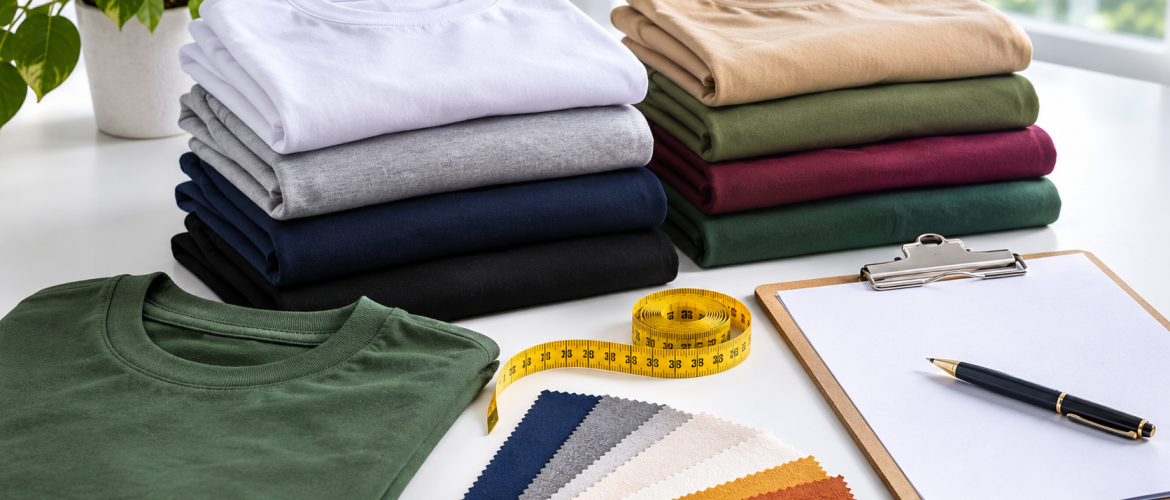
Two companies can order “500 black T-shirts” and receive completely different results. One gets a soft, fitted shirt that lasts. The other gets a thin, boxy shirt that fades. The difference is the specification.
When businesses brief T shirts suppliers, vague requests lead to vague results. A clear specification sheet tells the supplier exactly what to make and gives you a way to check the sample and the final order. This guide shows what to include. For help choosing a supplier, see our guides to selecting a T-shirt supplier in Dubai and choosing a T-shirt manufacturer.
What Is a T-Shirt Order Specification?
A T-shirt order specification is a written list of everything the supplier needs to produce your shirts: fabric, weight, fit, colour, design method, sizes, labels, packing and delivery.
Step 1: Define the Purpose and the Wearer
Start with who will wear the shirt and where. A shirt for an event giveaway has different needs from a daily staff shirt. Consider:
- Wear frequency (one event or daily use)
- Washing frequency
- Indoor or outdoor use
- Customer-facing or back-of-house
- Brand style (relaxed, smart, sporty)
Step 2: Choose the Fabric
Common choices are cotton, polyester and blends.
- Cotton: Soft and breathable, popular for everyday wear.
- Polyester: Light and quick-drying, often used for sports and outdoor wear.
- Blends: Combine properties, such as softness with easier care.
Ask the supplier to explain the properties of the specific fabric offered, including shrinkage and colour retention after washing.
Step 3: Specify the GSM
GSM stands for grams per square metre and describes fabric weight. A lower GSM generally means a lighter, cooler fabric. A higher GSM generally means a heavier, more structured fabric. Ask the supplier for the actual GSM of the sample, and compare samples side by side before choosing.
Step 4: Choose the Fit
Decide whether you need:
- Regular fit
- Slim fit
- Relaxed fit
- Separate men’s and women’s cuts, or a unisex cut
Ask for the size chart and check it against real people. If staff vary a lot, try a few sizes on before ordering.
Step 5: Choose the Neck, Sleeve and Hem Style
- Neck: Round neck, V-neck or a collared polo style. For collared options, see our polo shirts and T-shirts page.
- Sleeve: Short, long or sleeveless.
- Hem: Straight or curved, and the stitching style.
Round necks suit casual wear. Collared polo styles often look more formal for customer-facing roles.
Step 6: Fix the Colour
Colours look different on screen and on fabric. Provide:
- A brand colour reference
- A physical sample, if you have one
- The approved sample colour for repeat orders
Ask the supplier to confirm the colour on the actual fabric before production.
Step 7: Choose the Decoration Method
Common methods include printing, heat transfer and embroidery.
- Printing: Suits larger designs and graphics.
- Heat transfer: Suits detailed designs in smaller runs.
- Embroidery: Suits logos on polo shirts and smarter T-shirts, and is hard-wearing.
Ask which methods the supplier offers and which suits your design and fabric. Tex Design Uniforms offers in-house embroidery and printing.
Step 8: Specify Logo Size and Position
Give exact details:
- Logo size (width and height)
- Position (left chest, centre chest, back, sleeve)
- Number of colours
- File format and artwork
Ask for a digital mock-up showing the logo on the garment.
Step 9: Plan the Size Split
Order quantities by size, not as one total. If you have staff measurements, use them. If not, run a quick size survey. Add a small spare quantity for new joiners and replacements. Ask the supplier if they can advise on a typical size split for a mixed team.
Step 10: Add Labels and Packing Instructions
Confirm:
- Neck label (brand label or printed label)
- Care label
- Packing by size, department or name
- Packing method (folded, bagged, boxed)
Step 11: Approve a Sample and Run a Wash Test
Before the full order:
- Approve a sample in the final fabric.
- Check the fit on a few people.
- Wash the sample and check shrinkage and colour.
- Check the print or embroidery after washing.
- Approve in writing.
Step 12: Confirm Quantity and Delivery
Write down the final quantity by size, the delivery address, the delivery date and the contact person.
Sample Specification Sheet
| Item | Details to fill in |
|---|---|
| Fabric | Cotton, polyester or blend, plus the sample reference |
| GSM | As stated on the sample |
| Fit | Regular, slim, relaxed, men’s, women’s or unisex |
| Neck, sleeve, hem | Style for each |
| Colour | Reference and approved sample |
| Decoration | Method, size, position, colours |
| Sizes | Quantity per size |
| Labels | Neck and care labels |
| Packing | By size, department or name |
| Sample approval | Name and date |
| Delivery | Address, date, contact |
T-Shirt or Polo Shirt?
- T-shirt: Relaxed, casual and economical to produce for events, teams and giveaways.
- Polo shirt: A collared style that often looks smarter for staff who meet customers.
Choose based on the image you want and how the wearer will use it.
Common Mistakes
- Ordering by colour and quantity only
- Not checking GSM
- Skipping the sample
- Not testing after washing
- Ordering one total quantity without a size split
- Sending logo files late or in poor quality
Checklist Before You Order
- Purpose and wearer defined
- Fabric chosen
- GSM confirmed
- Fit chosen
- Neck, sleeve and hem chosen
- Colour reference agreed
- Decoration method chosen
- Logo position and size set
- Size split prepared
- Labels and packing confirmed
- Sample approved and washed
- Delivery details confirmed
How Tex Design Can Help
Tex Design Uniforms supplies polo shirts and T-shirts in Dubai and the UAE, with in-house printing and embroidery. Share your specification sheet and the team can review it with you. See our polo shirts and T-shirts page or contact Tex Design.
Conclusion
A clear specification turns a T-shirt order from a guess into a plan. With the fabric, GSM, fit, colour, decoration, sizes and delivery written down, T shirts suppliers can produce a sample you can check, and the final order is far more likely to match what you expected.
Frequently Asked Questions
What should a T-shirt order specification include?
Fabric, GSM, fit, neck and sleeve style, colour, decoration method and position, size split, labels, packing and delivery details.
What does GSM mean for T-shirts?
GSM means grams per square metre. It describes fabric weight: lower is generally lighter and higher is generally heavier.
Which fabric is best for company T-shirts?
It depends on use. Cotton is soft and breathable, polyester is light and quick-drying, and blends combine properties. Ask the supplier about the sample.
What is the difference between printing and embroidery on T-shirts?
Printing suits larger graphics. Embroidery suits logos and is hard-wearing, often used on polo shirts and smarter T-shirts.
How should I plan sizes for a bulk order?
Order by size, using staff measurements or a size survey, and add a small spare quantity for new joiners and replacements.
Should I wash a T-shirt sample before approving?
Yes. A wash test shows shrinkage, colour change and print or embroidery durability.
Should staff wear T-shirts or polo shirts?
T-shirts suit casual, event and team use. Polo shirts often look smarter for customer-facing staff.

No comments yet.