
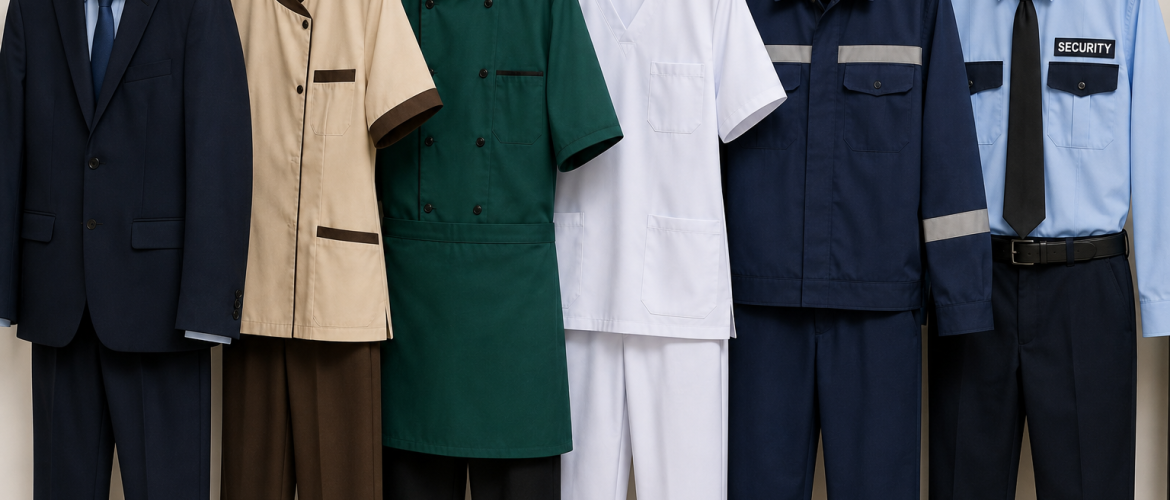
Uniforms are an important part of how a business presents itself to customers, employees and the wider public.
Whether you operate a hotel, restaurant, hospital, construction company, corporate office, security company or retail business, the uniforms your employees wear can influence how professional and organised your company appears.
A well-designed uniform can support brand recognition while also helping employees feel comfortable and appropriately dressed for their responsibilities.
However, achieving these results depends significantly on choosing the right supplier.
With many Uniform Suppliers in UAE offering different materials, customization options, prices and production capabilities, businesses should evaluate suppliers carefully rather than making a decision based only on the lowest quotation.
The right supplier should understand your industry, workforce, brand requirements, budget and operating environment.
This guide explains the most important factors businesses should consider before choosing a uniform supplier in the UAE.
Why Choosing the Right Uniform Supplier Matters
Uniform procurement may initially appear straightforward.
Choose a design, select a fabric, add a logo and place an order.
In reality, supplying uniforms for a business can involve several considerations, including:
- Fabric selection
- Employee comfort
- Sizing
- Colour consistency
- Branding
- Embroidery
- Printing
- Industry requirements
- Production capacity
- Quality control
- Delivery schedules
- Repeat orders
Problems in any of these areas can create additional costs.
For example, poor sizing may require replacements, weak fabric may wear quickly, incorrect branding can affect your professional image and delayed production can leave employees without the correct uniforms.
Working with experienced Uniform Suppliers in UAE can make the process easier from initial design through final delivery.
Businesses can explore the complete Tex Design Uniforms product range to see uniform categories available for hospitality, healthcare, corporate, industrial, security and polo-shirt requirements.
1. Understand Your Uniform Requirements First
Before requesting quotations, define exactly what your organisation needs.
Avoid beginning with a general request such as:
“We need uniforms for our staff.”
Instead, provide the supplier with specific information.
Consider:
- Number of employees
- Male and female staff requirements
- Departments
- Job roles
- Indoor or outdoor working conditions
- Uniform quantity
- Required colours
- Company branding
- Fabric preferences
- Expected delivery date
- Budget
- Frequency of repeat orders
Different departments within the same organisation may require different clothing.
For example, a hotel might need:
- Reception uniforms
- Housekeeping uniforms
- Waiter uniforms
- Chef uniforms
- Maintenance uniforms
- Supervisor uniforms
- Management clothing
Clearly defining requirements allows suppliers to recommend appropriate options.
2. Check the Supplier’s Industry Experience
Uniform requirements vary significantly between industries.
A corporate receptionist does not have the same clothing requirements as a construction worker.
Similarly, a nurse working a long hospital shift requires something very different from a restaurant chef.
When comparing Uniform Suppliers in UAE, check whether they understand your particular industry.
Experienced suppliers are more likely to understand practical issues such as:
- Workplace movement
- Climate
- Safety requirements
- Washing frequency
- Fabric performance
- Employee comfort
- Professional appearance
- Brand consistency
Tex Design Uniforms currently provides dedicated uniform categories for multiple industries including corporate, hospitality, healthcare, industrial and security environments.
3. Evaluate Fabric Quality
Fabric is one of the most important considerations when selecting uniforms.
Employees may wear their uniforms for eight hours or longer every working day.
Poor-quality fabric can quickly create problems including:
- Discomfort
- Excessive heat
- Colour fading
- Shrinking
- Loss of shape
- Fabric damage
- Poor professional appearance
When reviewing fabrics, consider:
Breathability
Breathable materials can be particularly important in the UAE climate.
Employees working outdoors or moving frequently between locations may require lightweight and breathable clothing.
Durability
Uniforms are often washed much more frequently than ordinary clothing.
The fabric should therefore withstand repeated use and laundering.
Comfort
Employees should be able to move naturally throughout their working day.
Appearance
The material should maintain a clean and professional appearance appropriate to your company.
Maintenance
Consider whether the fabric is easy to wash, iron and maintain.
The ideal fabric depends on the employee’s job role rather than simply selecting the most expensive option.
4. Prioritise Employee Comfort
A uniform may look excellent in a catalogue but still be unsuitable for employees.
Comfort should be considered alongside appearance.
Employees who spend long periods standing, walking or performing physical tasks need clothing that allows natural movement.
Think about:
- Fabric softness
- Breathability
- Fit
- Weight
- Sleeve length
- Trouser fit
- Stretch
- Ventilation
- Movement
A receptionist may prioritise a polished corporate appearance.
A warehouse employee may need durable clothing with greater freedom of movement.
Healthcare employees may need uniforms that support long shifts and regular movement.
Tex Design offers a dedicated Healthcare Uniforms range covering medical workwear such as nursing uniforms, tunics, trousers and scrubs.
5. Look for Custom Uniform Options
Every company has a different identity.
Uniforms should ideally support that identity rather than looking generic.
Customization can include:
- Company colours
- Logo embroidery
- Printed logos
- Contrast stitching
- Custom collars
- Staff names
- Department identification
- Sleeve details
- Custom cuts
- Special fabric combinations
Before selecting a supplier, ask how much flexibility is available.
Some businesses may only require a logo added to a ready-made garment.
Others may require completely customised uniforms designed around their brand.
The appropriate solution depends on your budget, quantity and branding requirements.
6. Consider Your Brand Identity
Uniforms are part of your company’s visual communication.
Customers may see employees before they interact with your website, brochure or marketing materials.
The uniform should therefore feel connected to the rest of your brand.
Consider whether the uniform matches your:
- Logo
- Brand colours
- Office interior
- Website
- Packaging
- Signage
- Vehicles
- Marketing materials
Consistent branding makes businesses easier to recognise.
For corporate environments, you can explore Corporate Uniforms including professional clothing designed for office and business environments. Tex Design currently lists corporate uniform solutions for a variety of industries and workplace requirements.
7. Check Embroidery and Printing Capabilities
Branding is often one of the most visible parts of a uniform.
A poorly embroidered logo can reduce the quality of an otherwise excellent garment.
Before ordering, review:
- Embroidery quality
- Stitch density
- Logo size
- Logo positioning
- Thread colour
- Printing quality
- Print durability
- Artwork accuracy
Ask whether branding work is handled internally or outsourced.
Tex Design states that embroidery, printing and tailoring are among the processes handled through its uniform production operations.
8. Request Samples Before Bulk Production
Samples are extremely important when ordering significant quantities.
A digital mock-up cannot fully show:
- Fabric texture
- Actual colour
- Weight
- Fit
- Stitching quality
- Logo appearance
- Embroidery quality
- Overall comfort
Where practical, ask for a sample before approving bulk production.
Review the sample carefully.
If several employees will wear the same style, allow a few team members to test the garment.
Their feedback may reveal issues that are difficult to identify by simply looking at the uniform.
9. Review Sizing Options
Uniform sizing can become complicated when hundreds of employees are involved.
A company may need:
- XS
- Small
- Medium
- Large
- XL
- XXL
- Additional sizes
Businesses should also determine whether different fits are available for men and women.
Incorrect sizing can result in unnecessary replacement orders and dissatisfied employees.
Before placing the final order:
- Collect employee measurements.
- Review the supplier’s size guide.
- Test sample garments.
- Confirm quantities by size.
- Keep a record for future repeat orders.
A structured sizing process can significantly reduce errors.
10. Consider the UAE Working Environment
Uniforms should be suitable for the location where employees actually work.
The UAE climate can be particularly relevant for employees who work outdoors, travel between sites or perform physically demanding work.
Uniform design may need to balance:
- Breathability
- Sun exposure
- Durability
- Professional appearance
- Safety
- Movement
- Washing requirements
Industrial employees may have additional requirements depending on their workplace.
Tex Design’s Industrial Uniforms range covers categories including construction clothing, coveralls and other industrial workwear, with customization options for business requirements.
11. Evaluate Uniform Requirements by Industry
Corporate Offices
Corporate uniforms should usually create a professional, polished appearance.
Common options include:
- Shirts
- Trousers
- Blazers
- Skirts
- Dresses
- Polo shirts
Explore Corporate Uniforms in Dubai for business clothing options.
Hotels and Restaurants
Hospitality uniforms must combine presentation and practicality.
Employees may include:
- Receptionists
- Waiters
- Chefs
- Housekeeping staff
- Catering employees
- Supervisors
Tex Design provides dedicated Hospitality Uniforms for hotels, restaurants, catering and other service businesses.
Healthcare
Healthcare professionals require uniforms that allow comfortable movement and support demanding work schedules.
Businesses can review Healthcare Uniforms for medical staff requirements.
Industrial Companies
Construction, manufacturing and technical businesses may require clothing designed around durability and workplace conditions.
Explore Industrial Uniforms for relevant workwear options.
Security Companies
Security uniforms need to provide a disciplined and easily identifiable appearance while remaining comfortable during long shifts.
Tex Design also provides dedicated Security Uniforms with custom and ready-made options.
12. Check the Supplier’s Production Capacity
Uniform requirements can range from a few dozen pieces to thousands.
Before choosing a supplier, confirm whether its production capacity matches your order.
Ask:
- Can you handle our quantity?
- How long will production take?
- Can different departments have different designs?
- Can all sizes be produced consistently?
- Can additional pieces be ordered later?
- Can you support future growth?
A supplier that handles a small initial order successfully may still struggle with a much larger rollout.
Production capacity becomes particularly important for organisations with multiple branches or large workforces.
Tex Design describes itself as both a supplier and manufacturer and states that it operates in-house production processes for custom uniform requirements.
13. Understand the Production Timeline
Never assume that custom uniforms can be produced immediately.
Production may involve:
- Design
- Fabric selection
- Measurement
- Sampling
- Sample approval
- Cutting
- Stitching
- Embroidery
- Printing
- Finishing
- Quality checking
- Packaging
- Delivery
If your uniforms are needed for a specific event, office opening, hotel launch or employee onboarding date, communicate the deadline early.
Ask the supplier for a realistic schedule.
A slightly longer production period with proper quality control may be preferable to rushing an important order.
14. Compare Pricing Carefully
Price matters, particularly for large uniform orders.
However, the cheapest quotation is not always the best value.
A low quotation may involve compromises in:
- Fabric
- Stitching
- Printing
- Embroidery
- Finishing
- Durability
- Quality control
Instead of asking only:
“Which supplier is cheapest?”
Ask:
“What are we receiving for this price?”
Compare suppliers based on:
- Material quality
- Customization
- Branding
- Production
- Delivery
- Replacement options
- Service
- Durability
The objective is to find a balance between cost and long-term value.
15. Understand What the Quotation Includes
When comparing quotations from different Uniform Suppliers in UAE, make sure you are comparing the same scope.
One quotation may include embroidery and delivery while another may not.
Ask whether the price includes:
- Garments
- Custom design
- Logo embroidery
- Printing
- Sampling
- Alterations
- VAT
- Packaging
- Delivery
Clear quotations reduce unexpected costs later.
16. Ask About Minimum Order Quantities
Some suppliers may require minimum quantities for customised garments.
This can be particularly important for smaller businesses.
Ask about minimum order requirements before spending time finalising a design.
Also discuss future smaller repeat orders.
For example, your first order may contain 200 uniforms, but six months later you may only need 15 additional pieces for new employees.
Understanding the supplier’s repeat-order policy can help avoid difficulties later.
17. Check Quality Control Procedures
Quality control should happen before uniforms reach your employees.
A proper inspection may review:
- Stitching
- Fabric
- Colour
- Sizes
- Quantity
- Logo placement
- Embroidery
- Printing
- Buttons
- Zippers
- Finishing
Tex Design states that its production process incorporates quality assurance checks to maintain garment standards.
For large orders, discuss the approval process before production begins.
18. Consider Repeat-Order Consistency
Uniform procurement is rarely a one-time requirement.
Employees leave.
New employees join.
Garments become worn.
New branches open.
Businesses should therefore consider whether the supplier can reproduce the same design in the future.
Consistency matters for:
- Fabric
- Colour
- Logo size
- Embroidery
- Fit
- Design
- Stitching
- Accessories
Keeping approved specifications from the initial order makes future ordering easier.
19. Evaluate Communication and Customer Service
Uniform manufacturing requires frequent communication.
You may need to discuss:
- Samples
- Measurements
- Logo artwork
- Colours
- Fabric
- Quantities
- Delivery
- Design modifications
A supplier that responds clearly and consistently can make the entire project easier to manage.
Poor communication during the quotation stage may become a larger problem once production begins.
Choose a supplier that understands your requirements and provides clear updates throughout the process.
20. Look for a Wide Product Range
Businesses often require more than one type of garment.
For example, a company may require:
- Corporate uniforms for office employees
- Polo shirts for technicians
- Industrial workwear for field staff
- Security uniforms
- Jackets
- Promotional T-shirts
Using one supplier for several requirements may help maintain consistent branding.
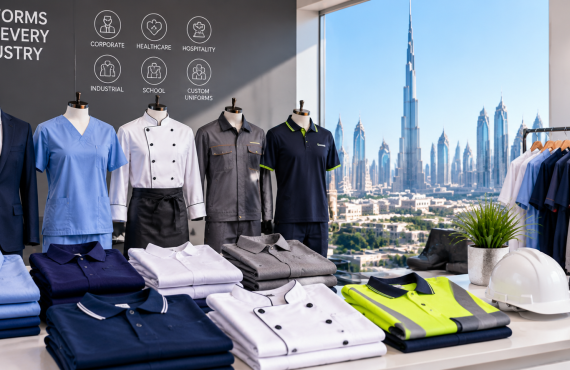
Tex Design currently lists hospitality, healthcare, corporate, industrial, security and polo-shirt categories within its uniform product range.
21. Consider Polo Shirts and T-Shirts for Casual Teams
Not every employee requires formal clothing.
Polo shirts and T-shirts can work well for:
- Retail employees
- Technicians
- Delivery staff
- Sales teams
- Promotions
- Events
- Outdoor teams
- Casual office environments
Tex Design’s Polo Shirts and T-Shirts range includes ready-made and custom options for businesses requiring branded casual workwear.
22. Check the Supplier’s Location and Delivery Coverage
Working with a UAE-based supplier can make communication, sample approval and repeat orders more convenient.
This can be particularly useful when businesses need to:
- Review physical samples
- Compare fabrics
- Confirm colours
- Check sizing
- Discuss modifications
- Arrange additional orders
Tex Design Uniforms operates from Dubai and provides uniform products across multiple industry categories.
Common Mistakes When Choosing Uniform Suppliers
Choosing Only by Price
The cheapest supplier may not provide the durability or quality your business requires.
Not Reviewing Samples
A photograph cannot show fabric feel, fit or stitching accurately.
Ignoring Employee Comfort
A beautiful uniform that employees dislike wearing is not an effective uniform.
Poor Size Planning
Incorrect sizing can lead to unnecessary replacements.
Not Checking Logo Quality
Branding should be reviewed before bulk production.
Ordering Too Late
Custom manufacturing requires time.
Ignoring Future Orders
Choose a supplier that can support new employees and replacement uniforms later.
Questions to Ask Uniform Suppliers in UAE
Before choosing a supplier, ask:
- How long have you supplied uniforms?
- Which industries do you work with?
- Do you manufacture uniforms?
- What fabrics are available?
- Can uniforms be fully customised?
- Do you provide embroidery?
- Do you provide printing?
- Can you produce samples?
- What sizes are available?
- What is the minimum order quantity?
- What is the expected production time?
- Can you handle large orders?
- How is quality checked?
- Can we reorder the same uniform later?
- Do you deliver throughout the UAE?
- Can you support different departments?
- Can colours be matched to our brand?
- What does the quotation include?
These questions can make supplier comparison much easier.
Frequently Asked Questions
How do I choose reliable Uniform Suppliers in UAE?
Evaluate the supplier based on industry experience, fabric quality, customization, production capacity, samples, sizing, quality control, pricing, delivery and repeat-order support.
Why is fabric quality important for uniforms?
Employees may wear uniforms for long periods and wash them frequently. Suitable fabric can improve comfort, durability and appearance.
Can business uniforms be customised?
Yes. Customization may include colours, fabrics, embroidery, printing, staff names, department details and garment design.
Should I request a sample before bulk production?
Yes, especially for large orders. A sample helps you evaluate fabric, sizing, branding, colours and finishing before approving production.
How should I compare uniform quotations?
Compare the complete specification rather than the final price alone. Check what fabric, customization, embroidery, printing, packaging and delivery are included.
Are different uniforms required for different industries?
Yes. Corporate, hospitality, healthcare, industrial and security environments have different requirements for comfort, appearance, durability and functionality.
Can uniforms include embroidered company logos?
Yes. Logo embroidery is commonly used for corporate, hospitality, industrial, security and other business uniforms.
Where can businesses order custom uniforms in Dubai?
Businesses can review the Tex Design Uniforms product range or contact Tex Design Uniforms to discuss their uniform requirements. The company’s current contact page lists its Dubai location and enquiry options.
Final Thoughts
Selecting the right Uniform Suppliers in UAE is an important business decision.
Uniforms are worn repeatedly and seen by employees, customers, visitors and business partners. They should therefore represent the company professionally while supporting the people who wear them.
When comparing suppliers, consider more than price.
Evaluate:
- Industry experience
- Fabric quality
- Comfort
- Customization
- Branding
- Embroidery and printing
- Sizing
- Production capacity
- Quality control
- Delivery
- Repeat-order support
- Customer service
Taking time to evaluate these areas can help businesses avoid quality problems and create uniforms that remain professional, practical and consistent with their brand.
For uniform requirements across multiple industries, explore the Tex Design Uniforms product collection, including Corporate Uniforms, Hospitality Uniforms, Healthcare Uniforms, Industrial Uniforms and Security Uniforms.
Businesses can also contact Tex Design Uniforms to discuss quantities, designs, fabrics, customization and other uniform requirements.

No comments yet.